
Introduction
Cricket calls itself a gentleman’s game, but controversy has always followed it closely. Over the years, umpiring decisions have changed matches, series, and even careers. Some decisions sparked outrage among fans, while others still divide opinions decades later.
Technology has reduced errors, but before DRS, cricket relied completely on human judgment. Even today, controversial calls continue to fuel debates, social media arguments, and endless replays.
In this article, we revisit the most controversial decisions in cricket history—moments that shocked players, angered fans, and became part of cricket folklore.
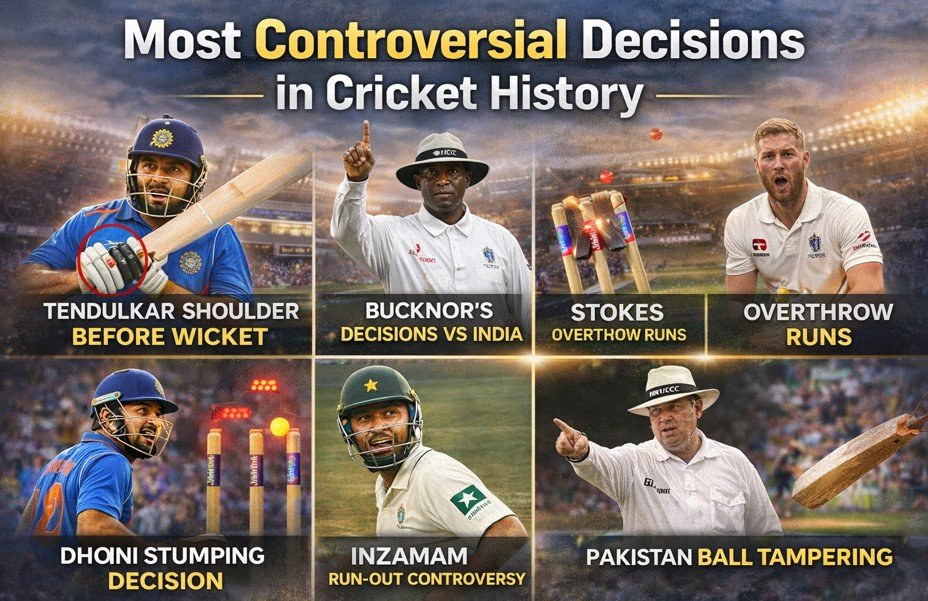
1. Sachin Tendulkar’s “Shoulder Before Wicket” (2003 World Cup)
Sachin Tendulkar was given out LBW against Australia in the 2003 World Cup final when the ball clearly hit his shoulder, not the bat or pad.
At that time:
- No DRS existed
- TV replays showed a clear mistake
- India lost its biggest batting hope early
This decision crushed Indian fans and remains one of the most painful umpiring errors in World Cup history.
2. Steve Bucknor’s Decisions Against India (2008 Australia Series)
Steve Bucknor became the center of controversy during the 2008 India vs Australia Test series, especially in Sydney.
Issues included:
- Incorrect LBW decisions
- Ignored edges
- Questionable judgment calls
Indian players and fans strongly criticized the officiating, and this series played a major role in accelerating the introduction of DRS.
3. Andrew Symonds’ LBW vs Pakistan (2008)
Andrew Symonds was given LBW against Pakistan when the ball clearly pitched outside leg stump.
This decision:
- Violated basic LBW rules
- Changed the momentum of the match
- Highlighted umpiring inconsistency
It became a classic example often cited when discussing why cricket needed technology support.
4. MS Dhoni’s “Not Out” Stumping (2019 World Cup)
MS Dhoni survived a close stumping decision during the 2019 Cricket World Cup.
The controversy arose because:
- The LED bails lit up milliseconds before the ball touched the stumps
- TV replays created confusion
- Fans disagreed on interpretation
Even with technology, this incident proved that cricket decisions can still divide opinion.
5. Ben Stokes’ Boundary Count Decision (2019 World Cup Final)
Ben Stokes was awarded six runs instead of five after an overthrow deflected off his bat during the 2019 World Cup final.
According to later clarifications:
- England should have received only five runs
- The incorrect call directly affected the final result
This remains one of the most debated decisions in cricket history, especially because it decided a World Cup winner.
6. Darrell Hair No-Ball Controversy (2006 Oval Test)
Darrell Hair accused Pakistan of ball tampering during the 2006 Oval Test against England.
The match saw:
- Pakistan refusing to take the field
- England declared winners by forfeit
- Massive controversy and legal debates
This incident damaged cricket’s image and remains one of the ugliest chapters in umpiring history.
7. Inzamam-ul-Haq Run-Out Decision (1992 World Cup)
Inzamam-ul-Haq was given run out in a crucial World Cup match under highly questionable circumstances.
The replays were unclear, and the decision sparked:
- Player frustration
- Fan anger
- Long-term debate
It showed how limited camera angles in the past often decided major matches unfairly.
8. Kumar Sangakkara’s Edge Given Not Out (2011 World Cup Final)
Kumar Sangakkara edged a ball clearly during the 2011 World Cup final, but the umpire ruled him not out.
India eventually won the match, but:
- Replays showed a clear edge
- Fans still debate the fairness
World Cup finals magnify every mistake, making this decision especially controversial.
9. Umpire’s Call Controversies in Modern DRS Era
Even with DRS, controversy continues—mainly due to umpire’s call.
Fans often question:
- Why marginal decisions stay unchanged
- Why reviews are lost even when the ball hits the stumps partially
Umpire’s call exists to respect on-field judgment, but it remains one of the most debated aspects of modern cricket.
10. Mohammad Kaif’s Dropped Catch vs England (2002)
Mohammad Kaif was involved in a controversial catch decision during the NatWest Trophy final.
The confusion over:
- Whether the catch carried
- Boundary rope involvement
sparked arguments that lasted long after India’s famous win.
Why Controversial Decisions Are Part of Cricket
Cricket decisions depend on:
- Human judgment
- Angles and technology
- Match pressure
- Split-second timing
Even with advanced tools, cricket cannot eliminate controversy completely. These moments, while frustrating, also add drama and emotion to the sport.
How Technology Changed Controversial Decisions
Since the introduction of DRS:
- LBW accuracy has improved
- Edges are detected better
- Major errors have reduced
However, technology cannot replace:
- Interpretation
- Game context
- Human decision-making entirely
Conclusion
The most controversial decisions in cricket history remind us that cricket is not just about runs and wickets—it is about emotions, moments, and memories.
Some decisions changed match results. Others shaped cricket’s evolution by forcing rule changes and technological upgrades. While controversies will never disappear completely, they remain an inseparable part of the game’s rich and dramatic history.
Related Reading (Internal Links)
- 👉 How DRS Works in Cricket – Simple Explanation for Fans
- 👉 Top 10 Cricket Records That May Never Be Broken